TL;DR:
This page is an open-access hub for a one-semester all-the-way-through-the-Bible course. It is a rich toolkit of links to a syllabus, 15 key Bible chapters, memory passages, book-by-book summaries, PowerPoints, maps, quizzes, crosswords/word scrambles, a gospel harmony, exam study guides, and an audio “Bible rap.” It also lists study aids (concordances, dictionaries/encyclopedias, atlases, abd commentaries), reading plans, and online Bibles, as well as notes on translations and inspirational quotes about the Bible.
This webpage and its linked resources provide open
educational materials for studying the Bible.
The class is suited for people with very little knowledge of the Bible as well as those who have a fairly good understanding of it.
This webpage includes an embedded video about why we believe the Bible is communication from God, as well as the Church of the Nazarene's doctrinal statement on the Bible.
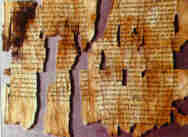
Photo of fragments of one Dead Sea Scroll
Open Educational Resources
This page and the resources linked from it are Open Educational Resources (OER)
"Then he opened their minds so they could understand the Scriptures." —
Luke 24:45
"Bib-Lit", as Introduction to Biblical Literature came to be called on the Southern Nazarene
University campus, is a one-semester all-the-way-through-the-Bible course that aims to stamp
out biblical illiteracy!
In this entry-level course, I tried to help students master basic Bible facts in chronological
order. We met 80 Bible characters and looked at 15 key chapters. We learned at least one phrase
about the content of every Bible book. By the end of the course, students were writing the entire
story of the Bible in one page.
" I stumbled across your internet pages on the Bible. I needed to get
back to basics and this helps. Thank you." -- Dan C., Florida
21 Memorable Sayings About the Bible
"The Bible is the only book where the Author is in love with every reader."-- Unknown (www.threads.net/@christian_vibes_global)
"Within the covers of the Bible are the answers for all the problems men face."-- Ronald Reagan, BrainyQuote.com
"The Bible does not change or get out of date. . . . It is our map and our guide."-- Billy Graham, "Answers," billygraham.org/answers
"The Bible is a window in this prison-world through which we may look into eternity."-- Timothy Dwight, Dictionary of Burning Words of Brilliant Writers p. 29
"The Bible shows the way to go to heaven, not the way the heavens go."-- Galileo Galilei, open letter to the Dowager Grand Duchess
"The Bible is the most valuable thing that this world affords."-- "Treasure for a Queen," Christianity Today
"The Bible will keep you from sin, or sin will keep you from the Bible."-- Dwight L. Moody, GoodReads.com
"The Bible is God's chart for you to steer by, to keep you from the bottom of the sea, and to show you where the harbor is, and how to reach it without running on rocks or bars."-- Henry Ward Beecher, www.azquotes.com
"The Bible was not given for our information but for our transformation."-- D.L. Moody, GoodReads.com
"In all my perplexities and distresses, the Bible has never failed to give me light and strength."-- Robert E. Leem BrainyQuote.com
"We must not select a few favorite passages to the exclusion of others. Nothing less than a whole Bible can make a whole Christian."-- A.W. Tozer, BrainyQuote.com
"Thousands of years have passed since the Bible was written... and yet the Bible stands. There have been emperors who have decreed the extermination of the Bible... But the Bible stands." ."-- Adrian Rogers, Sermon: "How to Make Your Bible Come Alive"
"The Bible is God's love letter to us."-- Billy Graham, Seattle Post-Intelligencer, September 6, 2007
"The Bible is a rock of diamonds, a chain of pearls, the sword of the Spirit; a chart by which the Christian sails to eternity, the map by which he daily walks, the sundial by which he sets his life, the balance in which he weighs his actions."-- Thomas Watson, Holman Old Testament Commentary
"The Bible is the ultimate truth filter."-- Todd Stocker
"The Bible is a mirror that reveals our need for a Savior."-- Kirk Cameron
"The Bible is the only book whose author is always present when one reads it."-- Darren Gregson, x.com/GregsonDarren
"The Bible is God's Word given in man's language."-- Max Lucado, www.AZQuotes.com
"The Bible contains the mind of God, the state of man, the way of salvation, the doom of sinners and the happiness of believers."-- Gideons Internattional
"The Bible is a book that has changed the world more than any other book in history."-- Tony Evans, quotefancy.com
"The Bible is a map for the traveler, a staff for the pilgrim, and a compass for the sailor."-- Gideons International
'What I Will Learn in an Introductory Bible Class?
In an introductory Bible course, you can expect to learn the Bible's historical context, its
major themes, key figures, and the noteworthy events it describes. Here are six areas that will likely be be
covered:
You will learn about the
organization of the Bible into the Old Testament and the New Testament. This includes
examining the various genres of biblical literature (e.g., historical narratives, poetry, wisdom
literature, prophetic literature, epistles (letters), and apocalyptic literature).
Knowing the historical and
cultural background of the ancient Near East during the time periods covered in the
Bible is a key to understanding Bible content, So the course will cover the political, social,
and religious context of ancient Israel and surrounding civilizations.
You will learn about the central themes and messages of the Bible. These include God's covenant with
humanity, salvation, redemption, justice, mercy, love, and the concept of the Kingdom of God.
An introductory course typically
covers key people in the Bible. These include the patriarchs such as Abraham, Isaac, and Jacob,
prophets like Moses, Elijah, and Isaiah, important kings (e.g., David and Solomon), and
prominent New Testament figures such as Jesus, the apostles, and other early Christian leaders.
You will study major events
recounted in the Bible. These include Creation, the Exodus, the Babylonian Exile, the life and
teachings of Jesus, his crucifixion and resurrection, and the early spread of Christianity.
You will be asked to critically engage with the text by asking questions, analyzing seeming contradictions or tensions, and considering different points of view.
Bottom line: An introductory Bible course should aim to provide you with an overall understanding of the Bible. It is a sacred text that comes from specific historical contexts, Yet, it has markedly influenced many cultures.
Class resources, including assignments, due dates, and exam study guides
What Nazarenes believe about the Bible:
"We believe in the plenary inspiration of the Holy Scriptures, by which we
understand the 66 books of the Old and New Testaments, given by divine inspiration, inerrantly
revealing the will of God concerning us in all things necessary to our salvation so that whatever
is not contained therein is not to be enjoined as an article of faith.
(Luke 24:44 47; John 10:35; 1 Corinthians 15:3 4; 2 Timothy 3:15 17; 1 Peter 1:10 12;
2 Peter 1:20 21)
-- Articles of Faith, Church of the Nazarene
Bible Study assignment instructions: There are a dozen of Bible Study assignment
sheets to be completed. They start with Genesis and go through Revelation. Along the way, you
will read about a fourth of the Bible. You will be asked to reflect on the lives of lots of 80 Bible
characters. Don't be overwhelmed. Here's what to do:
Turn each one in on time
Take the due dates calendar
and write those dates on the individual sheets as well as the master calendar of assignments that
you keep (I hope) for all your classes.
Bible Study sheets are due at the beginning of class period
Don't be overwhelmed that there are a dozen of them. Remember the Chinese riddle: Question: How do you eat an elephant? Answer: One bite at a time. [ read
more ]
Read the assigned Bible passages.
Read the textbook pages.
Answer each part of multi-part questions. Double-check to make sure you have done
this.
Crossword puzzles based on material in Discovering the
Bible, the textbook for Introduction to Biblical Literature. Click on numbers to retrieve
sheets.
"All scripture is God-breathed and is useful for teaching, rebuking, correcting and training in righteousness" -- 2 Timothy 3:16
Helps for Bible study
As you get deeper and deeper into the Word, you'll find the following of help:
Bible concordance
Alphabetical listing of words in the Bible with the verses in which they appear.
Several concordances or Bible search engines can be found online.
Bible dictionary
Alphabetical arrangement of explanations of Bible history, culture and general contents
Bible encyclopedia
Similar to a Bible dictionary with an alphabetical listing of topics and explanations. Covers more territory in greater detail than does a dictionary
Bible atlas
Geographical and topographical information on Bible lands, including geopolitical boundaries
Bible commentary
Scholar's comments on the meaning of the text of the books of the Bible, often verse by verse. Commentaries often are multi-volume sets
What will you get out of this Bible survery course?
Student comments from previous semesters:
"It helped me learn more about things I thought I knew."
"I read more of the Bible than I ever had before."
"I was exposed to stories in the Bible that I hadn't read before."
"We took 'field trips' that were very helpful."
"It brought the Bible to life."
Do you read novels? Then, let James Michener bring alive
for you the drama of Israel's turbulent past in his novel The Source. Michener is a
marvelous storyteller. In this 1965 book, Michener uses historical fiction to bring Israel's past
eras to life. The focal point of the novel is an archaeological dig at Tell Makor, an imaginary
mound that is the accumulated residue of abandoned settlements, each resting on the ruins of its
predecessor.
I don't agree with all of Michener's assumptions and theological conclusions. However, the
book can greatly help a peson sense the drama of biblical events.
Writing standards
Most courses at SNU contain a writing component.
I expect students to produce written work that is focused, well-developed,
organized, and relatively free of grammatical, punctuation, and spelling errors.
Papers falling short of this standard may not be graded. That work may be returned to the student
for further revision and resubmission. S
ee my writing checklist.
Ready for a light-hearted moment?
As we jump into the course, would you like a
chuckle? [ more ]
Note: The complete Bible is now available in 670 languages. The New Testament by itself has been translated into 1,521 more languages
while Bible portions have been translated into an additional 1,121 languages. Bibles in at least 65 languages can be found at Biblegateway.com