TL;DR:
Missionaries in Java face a cultural dilemma when invited to a slametan feast celebrating their neighbor’s new baby boy. While the invitation represents social acceptance and community belonging, the slametan itself includes rituals of offering food and incense to spirits for protection—practices rooted in Javanese folk Islam and animism. As night approaches, Jim must decide whether participation in such a culturally significant yet spiritually conflicting event can be reconciled with his Christian convictions.
Jim was interrupted in his preparation for teaching the next day at the Bible School by his wife, who reminded him that evening had almost come. With a start, he remembered the dilemma facing him, one that would require a decision within the hour. Earlier that afternoon, his neighbor had delivered an invitation to a slametan feast just after dark. Should he and his wife accept that invitation?
Jim and Anne West had lived in a small rural Javanese town for over a year. Before moving there, they had learned to speak Indonesian with reasonable fluency. They had acquainted themselves with the Javanese culture through observing and mixing with people.
After moving to the town, Jim and his family did their best to integrate themselves into the local community. Jim established good relationships with the local officials — the civil administrator, the military commander, the police chief, and the locally elected town mayor. His ability to speak Javanese gained him immediate respect, and his position as the pastoral supervisor of several congregations gave him a certain level of status in the community.
Jim and Anne also found that having three young children helped them establish relationships with their immediate neighbors. Soon after their arrival, Jim and Anne followed the local custom of inviting all their neighbors to a housewarming so that they could formally introduce themselves. Thereafter, they took every opportunity to chat over the fence and strengthen relationships in other ways. Living on church property, however, meant that non-Christians in that nominally Muslim society did not always feel free to visit them. Jim understood their hesitancy to step onto church property. Still, it made him feel as though they didn't fully accept him. Perhaps, he thought, this was a barrier that could never be overcome completely.
Jim's thoughts turned again to the invitation that had suddenly faced him with making a difficult choice. Earlier, when his neighbor's teenage son had come to deliver the invitation, Jim's reaction had been excitement and joy. It had seemed to signal that his neighbors had really accepted him and now regarded him as a part of the community. There was no need for an immediate reply to the invitation, for guests are expected to accept automatically unless they are unavoidably prevented from attending. Jim's initial euphoria passed, however, as the ramifications of accepting or rejecting the invitation began to sink in.
Jim had learned about the slametan during language studies and in conversations with other missionaries and local believers. It was a simple meal arranged by a family in connection with a big event in life, such as the birth of a child, circumcision of a male son, marriage, death, the building of a new house, the departure for a long trip, illness, or success in some important venture. In this case, the neighbor's wife had just given birth to a baby, and a son at that.

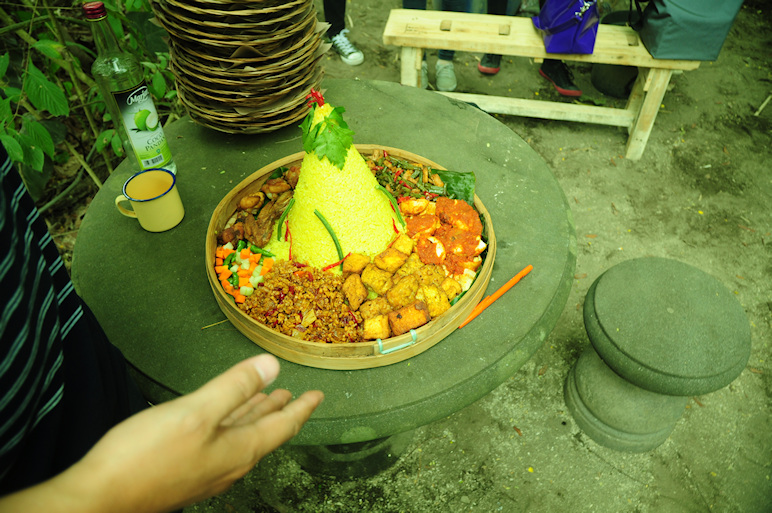
Jim knew that, for his neighbors, the slametan held far deeper significance than just an expression of joy for another son in the family. Central to the feast is a ritual designed to give protection from evil spirits. Even though the Javanese are nominally Muslim, their day-to-day lives are still very much influenced by fear of spirits and witchcraft. The slametan proper is an all-male affair, although women often gather in the kitchen or another room. After the invited male neighbors gather and are seated cross-legged on woven-leaf mats spread around the perimeter of the room, the host begins with an introduction and explains the reason for the gathering. Incense is burned, and specially prepared food is placed on mats in the center of the room. Normally, the food consists of rice and two or three side dishes. In the center is placed a cone of rice representing a mountain, which the Javanese traditionally regard as the source of well-being.
The food is not primarily for the guests. It and the incense are offerings to the spirits. Sometimes, in his opening speech, the host mentions the specific spirits concerned with this occasion and for whom the food is intended.
After the speech, someone is called upon to offer a prayer in the form of a Muslim chant song in Arabic. Sometimes, the local modin, or Muslim official, is specially invited for this purpose. At other times, the prayer is offered by anyone present who has learned the appropriate recitation. Its intent is protection against the harm that the spirits might bring (in this case, against the newborn baby). The guests indicate their participation in the prayer by holding their hands out with open palms and by saying "amen" at each pause in the chant.
After prayer, the host invites the guests to eat the food dedicated to the spirits, for those spirits have already been satisfied with the smell of the incense and the aroma of the food. Each guest takes some rice and a small amount of the side dishes. The rest is taken home to be eaten later. With that, the ritual is over.
The slametan serves two basic purposes. First, it reinforces the community's social solidarity by drawing the neighborhood together on all important occasions. Second, it fills a felt need for protection from misfortune So, in a sense, the feast preserves social and spiritual equilibrium.
As he reflected on this, Jim could see the pros and cons of accepting this invitation. On the one hand, accepting could mean that his relationship with his neighbors would move to a deeper leveland show that he identified with them in an important event in their lives. To reject the invitation could be taken as a rejection of his neighbors and their culture. Jim knew that many missionariesand some national Christians followed a policy of not attending the slametan. They felt that attendance would be seen as affirming the ritual as protection against the spirits. How could they participate in the prayer offered to a different god from Yahweh? How could they eat food offered to the spirits? These were the issues with which Jim struggled as twilight closed in. The time for reaching a decision could no longer be delayed. Finally, Jim decided to . . .
This case study is a revised version of one by Denis Green in Case Studies in Missions, edited by Paul and Frances Hiebert, Baker Book House. It may be reproduced only upon payment of a 35-cent royalty per copy to Baker Book House, P.O. Box 6787, Grand Rapids, MI 49516 USA
-- Howard Culbertson, hculbert@snu.edu
A slametan feast is a traditional Javanese ritual meal in Indonesia, particularly in Java. It has deep cultural and religious significance. It is often held to mark important life events such as weddings, births, circumcisions, and other milestones. The word "slametan" comes from the Javanese word "selamat," which means "safe" or "blessed."
During a slametan, a variety of dishes are prepared and shared. The meal typically includes rice, meats, vegetables, and traditional Javanese dishes. Snacks and desserts are also common alongside the main meal.
The slametan feast is not only about the food. It is also a communal gathering where prayers, blessings, and religious rituals are performed. These rituals are often led by a spiritual leader who guides the proceedings according to Islamic traditions (given that the majority of Indonesians are Muslims). Slametan feasts can also incorporate elements of Javanese mysticism, animism, or other local beliefs, depending on the cultural backgrounds of the participants.
Overall, a slametan feast is a way to express gratitude, seek blessings, and strengthen a community's social ties. It also reflects Indonesia's cultural diversity and religious syncretism.
Indonesian Christians have varying views on participation in slametan feasts. Their views depend on their individual beliefs, cultural background, and the specific context in which the feast takes place.
Some Indonesian Christians see participation in slametan feasts as an opportunity to engage with their wider community, to show respect for local customs and traditions, and to create goodwill and mutual understanding. They may view the communal aspects of the feast as compatible with their own values of fellowship and solidarity.
Other Indonesian Christians have reservations about participation in slametan feasts, particularly if they perceive elements of the ritual or the prayers involved would conflict with their Christian beliefs. They may choose to decline participation respectfully. Or, they may participate only in certain aspects of the feast while abstaining from others.


