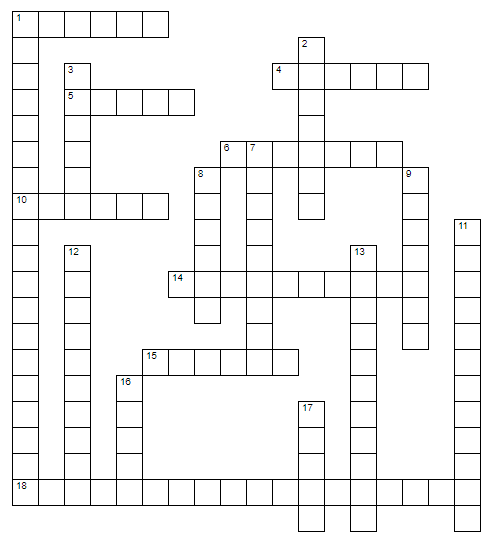
Challenge: Using the word bank below, can you solve this puzzle even if you are not taking this course?
| ACROSS | ||
| 1 | Main Reformed theologian. Used Augustine's teaching to affirm the "total depravity" of humanity and the doctrine of predestination | |
| 4 | Promoted a theory of evolution regarding origin of species. Originally a Christian, became increasingly agnostic. Used the phrae "survival of the fittest" | |
| 5 | Belief that God's fundamental characteristic is immutability; held that the Word (Jesus) was not eternal and is not God, but was created by God as the first of all creatures; ideas rejected by Council of Nicea | |
| 6 | Supported Copernican theory of the solar system | |
| 10 | Early systematizer of Christian doctrine; interpreted Bible allegorically | |
| 14 | Defended Christianity against Gnosticism and the doctrines of Marcion | |
| 15 | Founder of the Methodist movement, stressed personal experience with Christ, the sanctification of believers, and the need for Christ-followers to be involved in holistically meeting human needs. | |
| 18 | One who believed in "faith seeking understanding." Known for the "ontological" proof of the existence of God and for a clear statement of the substitutionary theory of atonement | |
| DOWN | ||
| 1 | Used Platonic philosophical tradition to defend and interpret Christian Faith; the sin of Adam was only a symbol of the fact that we all eventually would sin, affirming that all sin on their own account | |
| 2 | Held that there are two gods: one of the Old Testament and one of the New; Jesus did not come in a physical body nor was he born from Mary | |
| 3 | Staunch defender of rigid predestination | |
| 7 | Perhaps the most influential theologian in history; known for his doctrine of grace; humans do not have the power to decide on their own redemption | |
| 8 | German reformer who came to the conviction that salvation is by faith and not by works or by merits; declared that the Bible has more authority than all the councils of the church | |
| 9 | Insisted that truth is only one. Therefore, created a synthesis between Aristotle's philosophy and Christian faith | |
| 11 | Tried to show how Christian faith could claim for itself the best in ancient pagan philosophy (on the basis of the doctrine of the logos (or Word) | |
| 12 | Theory of solar system revolving around the sun | |
| 13 | His writings gave rise to existentialism | |
| 16 | History is the unfolding of the universal mind; developed a "system" that explained all of reality | |
| 17 | Most important Protestant theologian of 20th century; rejected the use of philosophy and emphasized divine transcendence and sovereignty; insisted on the function of theology as an assessment and evaluation of the life and proclamation of the church | |
Abelard | Anselm of Canterbury | Aquinas | Arius | Arminius | Augustine | Barth | Basil | Calvin | Chrysostom | Clement of Alexandria | Copernicus | Cranmer | Cyprian | Darwin | Eckhart | Edwards | Esebius | Galileo | Hegel | Ignatius | Irenaeus | Justin Martyr | Kierkegaard | Luther | Marcion | Melanchthon | Origen | Polycarp | Taylor | Tertullian | Wesley | Whitefield | Zanchi | Zwingli
Study guide for exam 1
Christian Thought main page
More puzzles -- Crosswords, word scrambles and word searches
-- Howard Culbertson, hculbert@snu.edu


